Thursday, March 12, 2026, 6:00 AM
Site: Trinity Moodle
Course: Trinity Moodle (Home)
Glossary: Math Notation Help
A
array $$\begin{array}{|ccc|}a_1&a_2&a_3\\ b_1&b_2&b_3\\ c_1&c_2&c_3\end{array}$$ is  |
|
B
beta (lower case greek letter) $$\beta$$ gives |
|
big sum $$\bigsum_{n+2}^x$$ is |
|
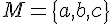
braces - Syntax: \left{...\right}
- Ex.: $$M=\left{a, b, c\right}$$ gives
 |
|
C
cdot (multiplication) $$a\cdot~b$$ gives |
|
chi (lower case greek letter) $$\chi$$ gives |
|
constants - Numbers in formulas are interpreted as constants and they are rendered in non-italic roman font face, which is a widely used convention.
- Following this convention, variables are shown in italic.
- Exp.: $$f(x)=3a+x$$ gives
 |
|
contour integral - General syntax for symbols with a kind of lower and upper limits:
\symbolname_{lowerexpression}^{upperexpression} - In general, there are two ways how these lower and upper expressions can be placed: centered below and above the symbol or in a subscript / superscript manner. In the first case the symbol name is preceded by the word "big", in the second there is no prefix.
- Syntax for the contour integral symbol:
$$\bigoint_{0}^{\infty}$$ gives
and $$\oint_{0}^{\infty}$$ gives 
$$\LARGE\bigoint_{\small0}^{\small\infty}$$ gives
and $$\large\oint_{\small0}^{\small\infty}$$ gives  |
|
coproduct - General syntax for symbols with a kind of lower and upper limits:
\symbolname_{lowerexpression}^{upperexpression} - In general, there are two ways how these lower and upper expressions can be placed: centered below and above the symbol or in a subscript / superscript manner. In the first case the symbol name is preceded by the word "big", in the second there is no prefix.
- Note: mimeTeX seems currently only to support the \bigcoprod command.
- Syntax for coproduct symbol:
$$\bigcoprod_{i=k}^{n}$$ gives
$$\LARGE\bigcoprod_{\small{i=k}}^{\small~n}$$ gives  |
|
D
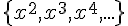
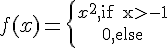
delimiters (overview) | Delimiters (parentheses, braces, brackets. ...) | | Command | Example | Result | \left(... \right) | $$2\left(a+b\right)$$ |  | | \left[... \right] | $$\left[a^2+b^2~\right]$$ | ![\left[a^2+b^2~\right] \left[a^2+b^2~\right]](https://moodle.trinitydc.edu/filter/tex/pix.php/ad294afe2a577ffb993175209d64eb1d.gif) | | \left{... \right} | $$\left{x^2, x^3, x^4,... \right}$$ |  | | \left\langle... \right\rangle | $$\left\langle a,b~\right\rangle$$ |  | | \left| ... \right| | $$\det\left|\array{a&b\\c&d}\right| $$ |  | | \left\| ... \right\| | $$\left\|f~\right\|$$ |  | \left{ ... \right. (note the dot!) | $$f(x)=\left{{x^2, \rm~if x>-1\atop~0, \rm~else}\right.$$ (\rm switches to roman style) | 
| \left.{ ... \right\} (note the dot!) | $$\left.{{\rm~term1\atop\rm~term2}\right}=y$$ |  | | | |
|
Note: The delimiters are automatically sizes. |
|